


The abacus, a calculating tool invented by the ancient Chinese over 2,000 years ago.
Although the abacus has somewhat fallen out of daily use in China today, as calculators and computers are widely used in modern times, just twenty years ago the abacus was still an important calculation tool for every household, not to mention accountants and merchants.
Today, it obviously still holds its place in children’s education throughout China and beyond, as it greatly facilitates math learning.
The Chinese abacus is highly favored by many teachers, parents, and children and has become an integral part of numerous educational methods.
Types of Chinese Abacus
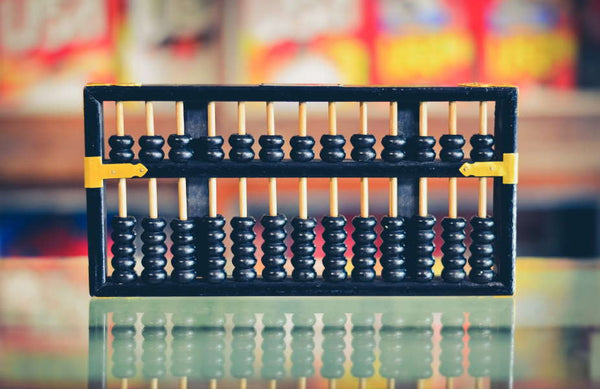
In the Chinese abacus, there are two beads on each rod in the upper deck and five beads on each rod in the lower deck. This configuration is used for decimal and hexadecimal calculations. The beads are generally rounded and made of wood or plastic. The beads are counted by moving them up or down toward the center beam of the abacus.
It is a joy to see an expert hand use an abacus—the beads click, fingers flutter, and within seconds, the answer emerges. In the past, aside from the ability to write elegant brush characters, businessmen also needed to skillfully use an abacus. Whenever there was a calculation, there was an abacus. The oldest known written documentation of the Chinese abacus dates back to the 2nd century BC (Han Dynasty).
The History of the Chinese Abacus
The Chinese abacus is an important element of traditional Chinese culture, symbolizing centuries of accumulated knowledge and mathematical practice.
Humanity’s relationship with mathematics began with counting. Earlier counting methods used stones, shells, and knots. The practice of using the Chinese abacus called “Zhusuan” is a unique, centuries-old method for performing arithmetic calculations.
Zhusuan is widely recognized as China’s fifth great invention and is also known as the Suanpan.
In Chinese, “zhu” means bead, which is also an integral part of the abacus, while “suan” means to calculate. By moving the beads, one can add, subtract, multiply, divide, calculate powers, extract roots, and even solve higher-degree equations. A special method is used for each operation on the abacus, enabling users to perform complex calculations.
Due to its calculation speed, convenience, and powerful capabilities, it has been called “the world’s oldest computer.”
Zhusuan is mentioned as early as 190 AD, in the Additional Notes on the Art of Figures by Xu Yue.
It is the only one of the 14 counting methods mentioned in the book still in practice today. By the 12th century, the practice of Zhusuan had been refined and had become a common calculation tool.
In a painting by artist Zhang Zeduan of the Song Dynasty, an abacus is clearly visible on the counter of a medicine shop near a busy street.

It was during this time that Zhusuan reached its peak as an important mathematical tool. Under the Ming Dynasty, Cheng Dawei’s Comprehensive Source of Calculation Methods reached Japan, greatly influencing Japanese mathematics. Historical records show that Zhusuan spread to South Korea, Japan, and Southeast Asia during the 16th century. Today, Zhusuan is widely used worldwide.
Founded in Beijing in 2002, the World Abacus and Mental Arithmetic Association now has 58 branches in 17 countries, including the United States, Australia, Russia, and Japan.

On December 4, 2013, Zhusuan was inscribed on UNESCO’s Representative List of the Intangible Cultural Heritage of Humanity.
At the end of the 20th century, the Chinese introduced mental Zhusuan calculations. It works on the principle of visualizing the abacus, allowing extremely complex calculations to be solved quickly.
The Chinese practiced Zhusuan throughout dynasties and ages. The modern practice is a culmination of ancient Chinese wisdom.
Recognized as intangible cultural heritage, Zhusuan is considered a unique way of thinking that will be passed down through generations and a craft with the power to change the world.
Benefits of the Chinese Abacus
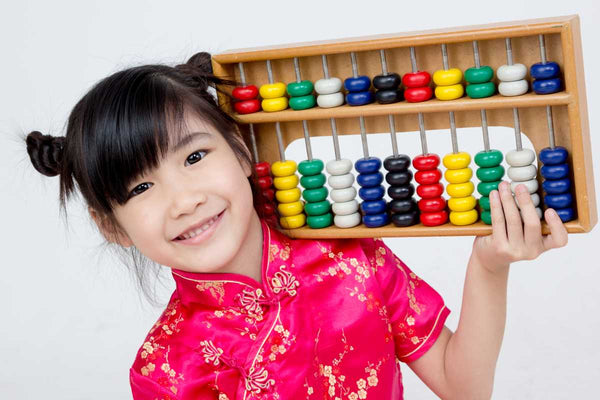
The benefits of the Chinese abacus are numerous and varied. The most obvious advantage is that it helps children learn math, but there are many other benefits, including:
- Supports fine motor skill development in young children by providing a tactile experience. It helps develop dexterity and eye-hand coordination.
- Enhances visual memory and concentration.
- Teaches children to think ahead, plan their moves, and improve anticipatory abilities.
- Improves mental calculation skills, especially in young children.
- Provides an intuitive understanding of numbers and basic operations (addition, subtraction, multiplication).
The Chinese abacus is more than just a calculating instrument: it is an educational toy that allows children to learn counting, addition, and subtraction intuitively, developing a deep understanding of mathematics. The Chinese abacus enables decomposition of each arithmetic operation.
Unlike calculators, the abacus requires mental counting and active engagement, especially for carrying over numbers. This encourages children to master their addition and multiplication tables well.
The Chinese abacus is a fantastic educational toy that greatly promotes early childhood development. It allows families to offer an early taste of learning to their children.
The Chinese abacus is suitable for calculations with whole numbers or decimals, supporting children from first to fifth grade (and beyond). Ideally, it is introduced around second or third grade, but it is also possible to introduce it to toddlers when they begin learning digits and the number system. There is no minimum age for introducing the abacus into school learning. As soon as a child learns to count, they can play with the Chinese abacus as a teaching toy to start representing numbers on the rectangular abacus frame. To represent a number, move the single-beads in the lower deck and the first bead in the upper deck along the horizontal beam on each rod. From right to left according to place value: first column = units, then tens, hundreds, thousands… (for decimals, digits before the decimal point are obviously left of the units column).
The suanpan is the most powerful educational game: it facilitates teaching elementary math and decimal system concepts. It introduces children to a level of abstraction—rather than counting on their fingers, they must decompose each number on the abacus.
Learning to use the Chinese abacus is a simple and fun educational game that helps children learn calculation and perform operations very easily. Knowing how to count on an abacus gives children an advantage. Many mathematicians recommend the Chinese abacus as an educational toy to learn math.